What is resistance?
Have you ever noticed how, just as you decide to do something good for yourself — rest more, exercise, set boundaries, book that appointment — something quietly gets in the way? And suddenly you’re tired. Or busy. Or telling yourself, “I’ll start next week.” This isn’t laziness. This is Resistance.
Have you ever noticed how, just as you decide to do something good for yourself — rest more, exercise, set boundaries, book that appointment — something quietly gets in the way? And suddenly you’re tired. Or busy. Or telling yourself, “I’ll start next week.” This isn’t laziness. This is Resistance.
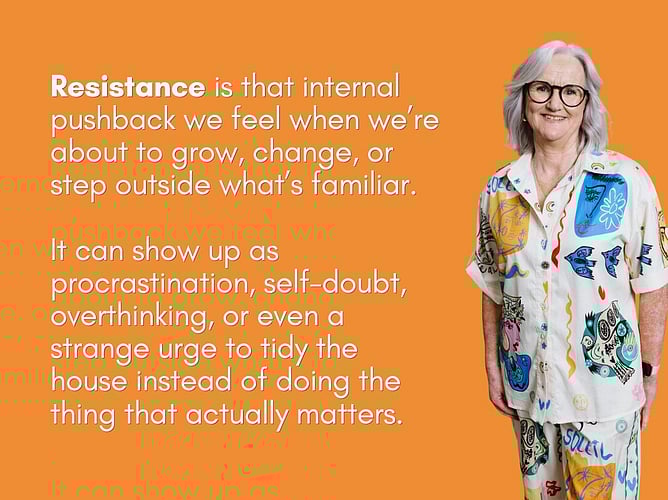
Resistance is that internal pushback we feel when we’re about to grow, change, or step outside what’s familiar. It can show up as procrastination, self-doubt, overthinking, or even a strange urge to tidy the house instead of doing the thing that actually matters. I know this from experience because when I was studying towards my Masters Degree I encountered all of the above.
And here’s the important part: Resistance doesn’t mean you’re doing something wrong.
It often means you’re doing something important.
Your primitive brain is trying to help (really)
Deep inside us is a very old part of the brain whose job is simple: keep us alive. It runs on what’s known as the motivational triad:
• Avoid pain
• Seek pleasure
• Conserve energy
This system worked brilliantly when survival depended on not getting eaten by a tiger as you stepped out of your cave in the morning. But in modern life, it can get a little confused.
Growth, change, and new habits all feel like:
potential discomfort (pain),
delayed reward (less pleasure now),
and effort (energy).
So your brain does what it thinks is best — it throws up resistance to keep you “safe”. This can look like my husband saying he doesn’t want to go the gym today yet its simply his brain putting up that resistance.
Why this matters for burnout
When you’re already depleted, Resistance can get louder. Your brain doubles down on conserving energy, even when the change you’re considering might actually restore you in the long run. That’s why burnout recovery isn’t about pushing harder. It’s about working with your nervous system, not against it.
How to gently move through Resistance
Instead of asking, “What’s wrong with me?” try asking:
“What is my brain trying to protect me from right now?”
“What would feel like a kind next step, not a heroic one?”
A few gentle strategies:
Name it: “Ah, this is resistance — not truth.”
Shrink the step: Make the action so small your brain doesn’t panic.
Lead with compassion: Safety comes before change.
Borrow regulation: Rest, breathe, walk, connect — calm first, then act.
Resistance softens when we stop fighting it.
A reframe I love
Resistance isn’t a stop sign. It’s often a signpost pointing toward growth.
And you don’t have to overcome it perfectly or powerfully. You just have to notice it — and choose kindness over criticism.

